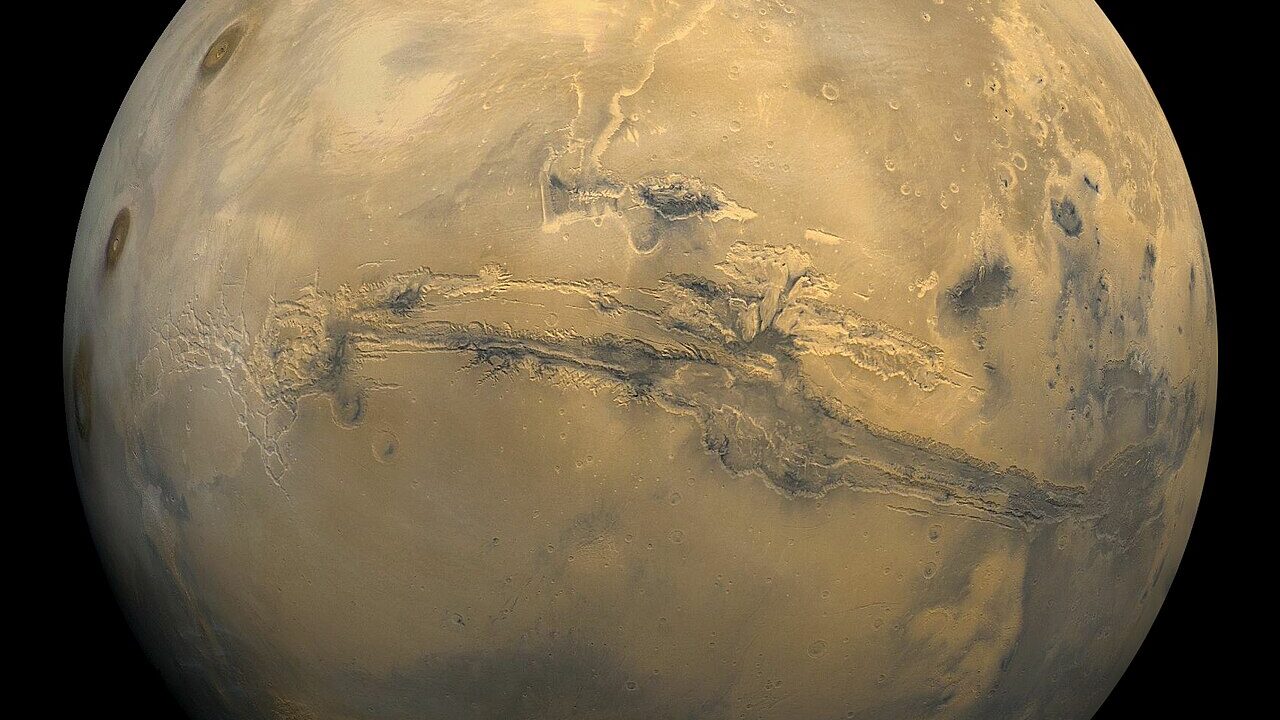
Mars just offered its most tantalising chemical hint yet that it was once a world where life could have begun.
Reanalysis of a rock sample drilled by the Curiosity rover in 2013 has revealed decane, undecane and dodecane — chains of 10, 11 and 12 carbon atoms — the largest organic molecules ever detected on the Red Planet. The sample came from the Cumberland mudstone in Gale Crater’s Yellowknife Bay, the bed of an ancient lake that existed roughly 3.5 billion years ago.
The molecules matter because of what they resemble. On Earth, carbon chains of this length are commonly fragments of fatty acids — the building blocks of cell membranes. The researchers who confirmed the finding, in results published earlier this year after years of laboratory work, are careful: the same chemistry can arise without life, and no one is claiming Martians.
What the discovery does establish is arguably just as important. Complex organic chemistry happened on Mars, and — critically — the planet’s rocks can preserve its signatures across billions of years of radiation and erosion. If life ever did gain a foothold in that ancient lakebed, Mars kept the receipts.
The finding sharpens the case for the next step in Mars exploration: bringing carefully selected samples back to Earth, where instruments far beyond any rover’s capacity could settle the question of biological versus non-biological origins. Until then, a mudstone drilled a decade ago on a cold lakebed, 200 million kilometres away, remains the loudest whisper in astrobiology.
Related reading: Rare Immune Cells in Abdominal Fluid May Be Shielding Tumors From Attack · Real-Time Oxygen Tracking Exposes Hidden Losses in Solar Water Splitting · Boosting a Protective Protein Halts Parkinson's-Linked Buildup in Mice